Complete Bearded Dragon Setup Guide
A step-by-step bearded dragon setup guide: enclosure, substrate, UVB and heat placement, basking platform, hides, thermometers, temperatures, and lighting schedule.
A bearded dragon's health depends almost entirely on its habitat, so getting the setup right is the most important thing you will do as a keeper. This step-by-step guide walks you through building a complete enclosure from the empty tank to a stable, dialed-in home, in the right order, so you can welcome your dragon into a habitat that works from the very first day.
Setup Essentials
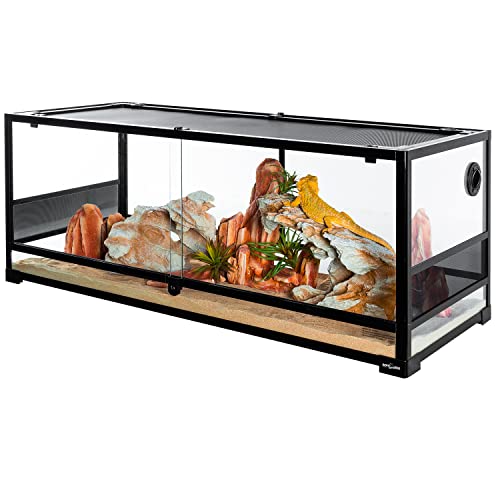
REPTI ZOO Extra-Long 48-inch Glass Terrarium
A spacious front-opening enclosure that gives a clear hot-to-cool gradient.

Zoo Med T5 HO ReptiSun 10.0 UVB Lamp (2-Pack)
The standard UVB to mount at the warm end above the basking platform.

REPTI HOME Reptile Basking Spot Bulbs (2-Pack)
Creates the 95 to 110F basking spot; pair with a thermostat.

INOSCIND Reptile Basking Platform Slate
Raises your dragon close to the lights for effective basking.
As an Amazon Associate we earn from qualifying purchases at no extra cost to you. Feeding and supplement guidance here is researched care information, not veterinary advice; confirm dosing with a reptile vet.
Step 1: Choose and place the enclosure
Begin with a 40-gallon-breeder at minimum, though 75 to 120 gallons or a 4x2x2 foot footprint is much better, since floor space matters more than height for these ground-dwelling baskers. Place the enclosure out of direct sunlight and drafts, on a sturdy stand. A front-opening design makes daily care and handling easier, and a secure screen top supports your lighting while preventing escapes. Size it for the adult your dragon will become: the bearded dragon size chart by age shows most reach 18 to 24 inches within about 18 months.
Step 2: Add the substrate
Lay down a solid substrate such as tile or reptile carpet, especially for babies and juveniles, to remove any impaction risk. Tile is durable, hygienic, holds basking heat, and helps file nails, while carpet is a soft, cheap starting point. Avoid loose sand, which dragons can swallow. Cover the whole floor so there are no exposed edges, and you have a safe, easy-to-clean base for the rest of the build. Loose particles swallowed with insects are the leading cause of impaction in bearded dragons, which is why solid substrates are the safe default.
Step 3: Install UVB and heat at the warm end
Mount a T5 HO 10.0 linear UVB bulb and a basking bulb together at one end of the enclosure so heat and UV overlap, mimicking the sun. Use a reflector on the UVB to push light down, and plug the basking bulb into a thermostat to control temperature. Keeping both light sources at one end creates the gradient your dragon needs, with a hot basking zone and a cool, shaded retreat at the far end.
Step 4: Add the basking platform and hides
Place a basking platform, such as a flat slate or resin ledge, directly under the lights to raise your dragon closer to the heat and UVB, both of which fade with distance. Add at least two hides, one on the warm side and one on the cool side, so the dragon always has a secure retreat at any temperature. Climbing branches and plants add enrichment and reduce glass surfing.
Step 5: Set up monitoring
Install digital probe thermometers at the basking surface and the cool side, plus a digital hygrometer. Avoid stick-on dial gauges, which are inaccurate. These tools let you confirm the basking spot reads 95 to 110F, the cool side reads 75 to 85F, and humidity sits at 30 to 40 percent. Accurate measurement is what separates a setup that looks right from one that truly is.
Step 6: Dial in temperatures and lighting
Run the lights and heat for several days, adjusting bulb wattage or platform height until both temperature zones read correctly and hold steady. Put the lights on a timer for roughly 12 to 14 hours in summer and 10 to 12 in winter, with no light at night. Bearded dragons depend on a consistent day-night cycle, so a timer keeps the schedule reliable and removes the risk of accidental all-night lighting.
Step 7: Add your dragon and observe
Once the readings are stable and correct over a couple of days, introduce your dragon. Give it time to settle without much handling at first, and watch its behavior: a healthy dragon basks in the morning, moves to the cool side to thermoregulate, eats well, and hides when it wants. If anything seems off, recheck your temperatures and UVB. With the setup dialed in, you have built the foundation for a long, healthy life.
Frequently Asked Questions
How do I set up a bearded dragon tank step by step?
Start with a 40-gallon-breeder or larger enclosure, add a solid substrate like tile, then mount a T5 HO 10.0 UVB bulb and a basking bulb at the same warm end. Add a basking platform under the lights, place a warm hide and a cool hide, install digital thermometers and a hygrometer, and run everything on a thermostat. Dial in a 95 to 110F basking spot and a 75 to 85F cool side over a few days, then add your dragon once temperatures are stable.
How long should I run the lights each day?
Provide roughly 12 to 14 hours of light per day in summer and around 10 to 12 in winter, using a timer so the cycle is consistent. The UVB and basking lights go off at night. Bearded dragons rely on a regular day-night cycle for healthy behavior, appetite, and sleep, so a timer takes the guesswork out and prevents accidental all-night lighting. Adjust seasonally to mimic natural daylight, and keep the schedule steady day to day.
What temperatures should a bearded dragon setup have?
Aim for a basking surface of 95 to 110F for adults, with juveniles a touch hotter, and a cool side of 75 to 85F so the dragon can thermoregulate. At night, no heat is needed as long as the room stays above the mid 60s. Measure with digital probe thermometers at the exact spots the dragon uses, not stick-on dials, and adjust bulb wattage or platform height until both ends read correctly before the dragon moves in.
Where should I place the UVB and basking bulbs?
Mount the UVB and basking bulbs together at one end of the enclosure, the warm end, so heat and UV overlap on the basking platform, just like the sun in the wild. This creates a clear gradient with a hot, well-lit basking zone and a cooler, shaded retreat at the far end. Set the basking platform height so the dragon sits at the UVB bulb's recommended distance, often 8 to 12 inches for a T5 HO 10.0 through a screen.
How long should I wait before adding my dragon?
Set the enclosure up and run it for several days before introducing your dragon so you can confirm the basking spot, cool side, and humidity all hold steady at the right levels. This burn-in period lets you fix any temperature or equipment problems without stressing the animal. It also lets new decor off-gas any odors. Once the readings are stable and correct over a couple of days, your dragon can move into a properly working habitat.
Do I need a basking platform in the setup?
Yes, a basking platform greatly improves the setup by raising your dragon closer to the heat and UVB, both of which fade quickly with distance. A flat slate, log, or resin ledge under the lights gives the dragon an effective, comfortable place to bask and drive digestion. Set the platform height so the basking surface reads 95 to 110F and the dragon sits within the UVB bulb's recommended distance. It turns a good lighting setup into an effective one.
Need more help with your bearded dragon?
Browse our guides by topic to find practical solutions.
Care Planner: $39